Chiropractic, a second look

Many D.C.s are great. If you are seeing a chiropractor and have had good success, fantastic! I am the last person to interfere with something that’s working. But if your “genius” has been “fixing” you for years and you are still the same as when you started… it might be time to rethink chiropractic.

Sure, you get temporary pain relief and a nice endorphin rush… but does it last? And is there a cost?

I am NOT a fan of the subset of chiropractors who indiscriminately and overzealously use HVLA adjusting (high-velocity, low amplitude – you know, that violent cracking). Low-force chiropractic like Network, BGI, and activator is absolutely safe, and there are lots of other techniques besides HVLA that are fine. HVLA is appropriate when used to correct an acute injury, like putting a dislocated shoulder back in the socket, but it should not be a frequent therapy. Repetitive stress of supportive ligaments and the resulting inflammation will actually damage the joint.

My information comes from my time at chiropractic school (I completed the first year, including the entire series of cadaver dissection, with nearly straight A’s), my knowledge of functional anatomy as a certified personal trainer and amateur bodybuilder, my 10 year partnership with an Osteopathic medical doctor, my experience seeing patients who have been damaged by repetitive HVLA, and discussions with many physicians of all types. I welcome input from any chiropractor who is interested in a fact-based discussion.

Personally speaking, I suffered a terrible injury when my car was broadsided in the first week of chiropractic school. Their treatments were making me worse, and the more I learned in school, the more I understood why.

1) It doesn’t treat the cause of the problem. Bones don’t move by themselves. If a bone is repetitively out of place, it’s because there’s a tight muscle pulling it that way, or a weak muscle failing to hold the bone in place. Jamming the bones back will cause micro-tears of that tight muscle. It feels good immediately, because you get a nice adrenaline rush along with your temporary fix. An enlightened chiropractic teacher compared HVLA to the shock and rush you get from a shot of vodka. Addicting, but not necessarily good for you. Unfortunately, as soon as the muscle goes back to its usual tight, spasming self, the bone will be pulled back out of alignment. That’s why you need to go back to the chiropractor the next week. Acupuncture and medical massage use the neurological system to retrain those tight muscles, so real healing can begin.

2) Our ligaments and tendons are there for a reason. They provide much-needed joint stability and hold us together. Repetitive HVLA weakens them, and can destroy your joint integrity. We all know that an ankle, having been sprained three times, is pretty much guaranteed to twist again. You do not want that floppiness in your spine. You should not able to crack-crack-crack your back simply by stretching. That’s called hypermobility and it means you can move too much. If you have already been damaged by too much HVLA, you will need to strengthen your back and abdominal muscles to help support those loose ligaments and tendons. Hypermobile backs are more likely to suffer a serious injury if you have an accident (this is what happened to me!).

3) Your reflexes work against HVLA. Quickly yanking on a muscle – even a relaxed one – can cause damage and inflammation. There’s a built in protective reflex that tightens a muscle when it is suddenly lengthened. You can feel this: Fold your friend’s arm at the elbow and put your hand on their bicep. Straighten the arm quickly, and you can feel the bicep twitch under your hand. Now imagine that happening to an already-sore neck muscle being snapped.

4) The pop means nothing. The cracking sound doesn’t necessarily mean you’ve been adjusted properly. It’s called cavitation, and it means that nitrogen gas, naturally occurring in your joint fluids, has been released. A similar thing happens when you open a can of soda. The sound means the bones have been rapidly separated (opening the joint space) and then have come back together. They may have come back to the same position, a better one, or a worse one. Misalignments, when corrected gently OMM style, do not make a cracking noise because the joint space is eased into the correct position rather than violently forced.

5) First, do no harm. Some chiropractors don’t bother to diagnose which level is dysfunctional. They just “shotgun” you by cracking all the vertebrae in your spine. Then they flip you over and do the other side. Why cause stress and create inflammation in a joint that’s working? Added bonus: Whenever you have inflammation, scar tissue forms. Trauma (HVLA) every week leads to more and more scar tissue building up. That’s the last thing you need when you’re already hurting.

6) With repetitive strong adjustments, your body becomes dependent on that input. In chiropractic school we joked about “welfare spines.” I had a discussion with an instructor who was brutally blunt about the temporary nature of his treatments. “Of course they have to come back. That’s how you buy your boat.” I found that model of “medicine” distasteful and unethical. I prefer to help the body heal itself. I love acupuncture and OMM because they truly correct how your muscles function.  Combined with proper exercise*, this creates a body that is strong and capable of bouncing back after a minor injury. I don’t want to see you every week for the rest of your life. I’d prefer to get you better and self-sufficient, and then stay in business by fixing all your friends and family. :)

7) Some chiropractors think that HVLA is “the only way to reset a nerve.” That may be their only tool, but I can reboot the nerves that control muscles with acupuncture, Still, counterstrain and Sotai techniques. These last three are advanced medical massage methods that are easier to explain in person – ask me when you come in!

BTW:  “But I can’t help it!” When you are out of alignment, your body will naturally feel compelled to snap itself back in place. After my injury I used to violently crack my neck and back all the time. It never really solved the problem, though… refer to point 1 above! The good news is that the desire to self-adjust melted away when my muscles – and more importantly, the neurons controlling those muscles – were corrected by acupuncture and Osteopathic medical massage.

*Exercise is essential to strengthen weak muscles, remind tight ones how to relax, and get all your muscle fibers integrated and working together. We are built to move! I know firsthand how pain makes you want to curl up on the couch and wait for it to heal, but the hard truth is that it won’t really repair until you put in the work. Get on an anti-inflammatory diet, see me for basic physical therapy-type exercises, and start walking! Better yet, see an expert personal trainer.

Du-4 (warm the Yang, lower back pain, low energy, infertility or ED)

Mingmen, the Gate of Life (AKA Du-4) is located in the center of the spine, just below the 2nd lumbar vertebrae. It’s used for building Yang, treating infertility or sexual issues such as erectile dysfunction, and for lower back pain or weakness.

Be careful stimulating this point if you are using acupressure, since it’s often tender.  Applying heat can be useful, especially If you tend to be cold. In my clinic, of course, I use acupuncture and an infrared therapy lamp. At home, you can direct a warm shower stream onto it or use a microwavable rice bag (I have them at the office if you need one).

Also good for lower back pain: LV-3, BL-40 and GB-34.


The Shoulder

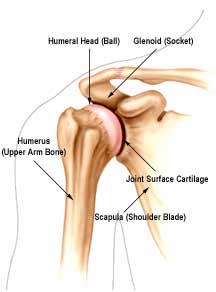
Anterior (front) view of the bones of the shoulder joint.

We can do amazing things with our arms. Lift them overhead, cross our chests, even link our hands at our spines. In fact, the shoulder is the most mobile joint in our bodies, thanks to its “ball and socket” configuration. See how the head of the humerus (upper arm bone) fits into the scapula (that triangular bone in your upper back) like a baseball into a glove? It can spin on the smooth, round surface to provide a spectacular range of motion.

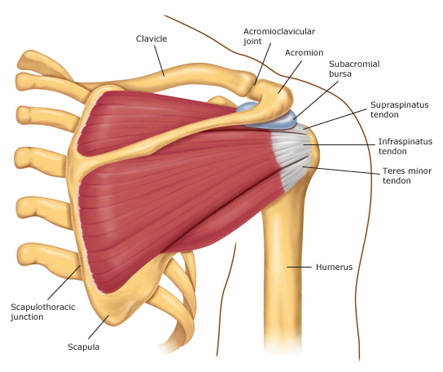
The posterior (back) view of the shoulder.

Just as with national politics, there’s a trade-off between freedom and stability. The complexity of this joint makes it prone to a variety of injuries. Cartilage lines the articulating joint surfaces to create a smooth track for movement. If torn, it takes a long time to heal and may require surgery. There’s the bursa, a fluid-filled sac that provides cushioning. Inflammation here, called bursitis, can be very painful. Rest, ice, anti-inflammatory drugs, and acupuncture are the best treatments (of course an anti-inflammatory diet will help, too). The well-known rotator cuff is actually a set of four deep muscles that stabilize the joint and work to rotate the humerus. Three (supraspinatus, infraspinatus, and teres minor) can be seen in the drawing of the back view of the shoulder. The fourth, subscapularis, attaches to the front of the scapula and goes to the front of the humerus and the joint capsule. With a minor tear, they will require rest and then specialized exercises. Severe tears require surgical intervention.

Overtop the rotator cuff is a layer of larger muscles, such as the latissimus dorsi & teres major (back), and the pectoralis muscles (front), and the deltoid (that roundy bit at the corner). These are your heavy duty movers. Ironically, since the lats and pecs both attach to the front of the humerus, unbalanced exercising can lead to an internally rotated (palms towards the back) shoulder, or “ape” posture. This is a great example of the importance of an intelligent, balanced workout plan. Then of course there are all the muscles that continue down the arm to control the elbow, including the triceps and biceps.*

If any of these muscles are dysfunctional, the bursa is irritated, or the cartilage is torn, you can have shoulder pain and loss of range of motion. Connective tissue can adhere, and scar tissue builds up over time. In extreme cases, you can develop Frozen Shoulder, which is exactly what it sounds like. It just won’t move. There are other causes of shoulder pain, too, ranging from nerves being pinched at the neck to gallbladder disease, but these musculoskeletal problems are the most common.
Acupuncture can reduce inflammation, increase bloodflow, relax tight muscles, and speed healing. I can also perform Osteopathic medical massage to break up scar tissue, release myofascial adhesions, and retrain the neurological system. This allows chronically tight muscles to return to normal. In most cases, therapeutic exercise is important for complete healing.

*Please note that I’m simplifying the anatomy quite a bit  for the purposes of this article. If you’re interested in all the marvelous details of our bodies, I highly recommend Netter’s Atlas.

LI-4 (headache, arm or facial pain, infection, hot flashes)

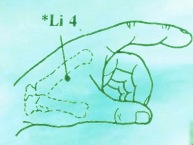
LI-4: Hegu. This point is astonishingly useful for a wide variety of complaints, but don’t use it if your patient is pregnant!

Large Intestine 4 is the acupoint most well-known by the general public. I first had it taught to me by a riding instructor when I was a kid living in rural Virginia. The name for this point is Hegu, “Joining Valley,” which is a reference to its anatomical location on the back of your hand, in that fleshy area between the thumb and forefinger. Feel around – it’ll be tender if you need it – but the easiest way to find it is to squeeze your thumb against your hand. The highest point of the muscle is where you want to press. Use firm, gentle pressure for 10-20 seconds with a healing intention. Try both sides.

Hegu, or Joining Valley, is a tremendously useful point. It moves stagnation, so you can use it to clear pain and stiffness anywhere in the upper body. Hegu will be particularly effective along the LI channel, which runs from the nail of the forefinger, along the forearm to the lateral (outside) elbow, up the arm and across the shoulder, eventually crossing the upper lip to end at the opposite side of the nose. Shoulder and elbow pain, carpal tunnel, and (of course) headaches are common uses. It’s specifically the Ruler of the Face, so it’s doubly powerful for frontal headaches, eye pain, sinus blockage, and tooth pain. It also releases heat and is part of a point combination for fighting viral or bacterial infections. If  you are prone to hot flashes, this point could be your new best friend. Also use LI-11, pictured here, to clear heat.

And by the way… the leading cause of headache is dehydration. Drink a glass of water!

WARNING: Because Hegu is a moving point, DO NOT use it if you are pregnant or bleeding. It can induce a miscarriage or increase blood loss. On the other hand, if you are overdue and want to evict your baby, this is a great way to do so, along with some other points (assuming everyone is healthy and it’s not a complicated pregnancy!). It will usually increase menstrual flow if the patient is having her period. If you have a severe headache paired with sudden loss of motor control or speech, get to a hospital immediately. DO NOT use LI-4 until you are sure you are not having a hemorrhagic stroke (bleeding inside the brain). This goes for head injuries, too!


Unexplained pain & its various causes

There are many reasons your body can hurt. It’s really frustrating when you don’t understand why, but often unexplained pain just means it doesn’t fit into a nice diagnostic box. We’re all familiar with muscle strain/sprain, fatigue, inflammation, and arthritis… you probably already know that acupuncture can help with these. Less understood by the general public are these causes of pain:

Viscero-somatic referral (Viscero= organ, Somatic=relating to the body): In this case your brain misreads a distress signal, so an organ problem feels like a muscular problem. The most famous example is the heart attack that creates an aching arm or jaw, or bone cancer masquerading as a back strain. Pain that doesn’t respond to treatment needs to be assessed by a medical professional to rule out dangerous causes.

Chronic spasticity: Healthy muscles are constantly changing their level of tension. They work with constant feedback from the cerebellum (part of the brain) to make tiny adjustments. This is how we keep our balance and perform tasks smoothly. When a muscle is tight for a long period of time, however, its setpoint changes. It thinks being tight is normal – this is called spasticity. It leads to stiffness, pain, and misalignment of bones as they are pulled out of place. Blood flow is blocked, creating painful ischemia. Tight muscles and misaligned bones can pinch nerves causing “electric shocks,” tingling, or numbness. This is what I see most often when people come in with unexplained pain. There’s nothing to show up on an X-ray or MRI, because the problem is functional, not structural. Massage is a great temporary relief, but to really fix it you need to treat the cause of the problem, the neurological setpoint. Acupuncture and Osteopathic-type medical massage remind the nerve controlling the muscle how it’s supposed to behave. Once the muscle relaxes, bones return easily to their proper place, and the body can heal itself.

Fascial adhesions: Each muscle fiber has connective tissue, called fascia, surrounding it like a layer of Saran wrap.

Connective tissue (white) and muscle fibers. When fascial adhesions form, it can cause unexplained pain.

Connective tissue (white) and muscle fibers

It may help to picture a muscle fiber as a drinking straw in a paper wrapper (sheath of fascial connective tissue). At each end, that fascia becomes our tendons. These sheaths are supposed to slide past each other as muscles move. With long periods of no movement, if the muscles are spastic, or if there’s an injury, they can stick together and form a fascial adhesion. When your muscles are shrink-wrapped together, it can cause muscle stiffness and unexplained pain. Some people like to get in and dig the adhesions apart, deep-tissue massage style. That works well in the short term, but it also causes inflammation… which causes scar tissue… so the adhesions reform.

Myofascial release can help with unexplained pain.Myofascial release, a type of medical massage, uses a more subtle approach to slide the layers apart. I love doing this type of work because the result is immediate freedom of movement with no pain and no boomerang side-effects.

Emotional causes of pain: Sometimes the pain of an injury lasts far longer than it logically should. This usually points to an emotional attachment. The brain literally links the muscular dysfunction with the memory, and the unresolved post-traumatic stress around the incident will actually prevent the body from completely healing. This can happen with gradual, cumulative injuries too: Imagine a tight neck from a job you hate. Patients will frequently have an emotional release when we start working on the physical site. They may start crying, giggling, getting angry, or suddenly find themselves terrified “for no reason.” Once we get those remaining feelings flushed out, the muscles and tendons often recover rapidly. If you feel something emotional happening during a session, let it out! Releasing pent-up emotions is therapeutic for your body as well as your soul.

Doctors used to blow off psychosomatic illnesses as “all in your head” and not worth treating. The medical community now has a better understanding of the interplay between the mind and body. It’s a two-way street, and they affect each other profoundly. Chronic pain will screw up your neurotransmitters (chemicals in your brain) and temporarily change your personality. Likewise, an overthinking, worried mind can trigger digestive troubles like IBS (Irritable Bowel Syndrome).

If you have a chronic injury that isn’t healing, it’s worth reflecting for a few minutes. Is there anything your body is trying to tell you? If so, consider talking it out with a therapist or a good friend. Acupuncture can help balance your emotional life, but there may be some work needed on your part, too. Of course you’re welcome to discuss anything in our sessions, and your confidentiality is always assured.


Fibromyalgia & how to beat it

The FIRST thing to know about Fibromyalgia is that it’s real.

The SECOND thing to know about Fibromyalgia is that it doesn’t have to be forever.

So many people, when they are finally diagnosed, have a bittersweet reaction. At last, they know what is wrong. They might feel vindicated, having endured the eye-rolls and boredom of family members who didn’t believe anything was really wrong. On the other hand, some patients take the diagnosis as a death sentence. They’ve heard nothing but a negative prognosis. They think they are stuck with the pain for the rest of their lives. Some people, exhausted and depressed, can even take on the disease as an identity. DO NOT do this. You are a beautiful person dealing with a temporary disease. There’s a Southern saying “If you’re going through Hell, don’t pitch a tent!” This is perfect advice. Resist the urge to wallow. Focus on the things you CAN do to make yourself better, and keep moving!

Everyone is different, of course, but I am here to tell you that most people CAN reduce or even eliminate Fibromyalgia symptoms. I used to be in a lot of pain… Now, as long as I am reasonable with my diet and exercise, my symptoms are very mild and very manageable! Let’s see how much progress we can make.

I see FM as a kind of physical Post-Traumatic Stress. Generally it can be traced back to a physical or emotional trauma. The body’s pain system becomes oversensitive. It reads any little insult as a major injury. To stop this over-reaction, we have to decrease inflammation, reduce stagnation, and decrease stress.

Sleep: See my article on Sleep. Letting your body restore itself overnight is very important!

Exercise: Light, frequent exercise is key to reducing pain. In severe cases, you may need to start with a 5-10 minute walk once a day. That’s fine… just gradually increase the duration. Get up and move a little every few hours instead of sitting still all day. If all you can do is make snow angels in bed, do that. Try to keep your activity levels about the same day to day. Doing too much or being too sedentary will hurt – listen to your body!

Nutrition: Making a few changes in your diet can drastically reduce your pain. Avoid the inflammatory nightshades (tomatoes, potatoes, eggplant, peppers, tobacco) as most people with FM tend to be sensitive to their natural alkaloids. This article contains full details and some recipes. Sugar is the other big offender. Some people are more sensitive to dairy products, commercial red meat, alcohol, and caffeine than others. It’s worth experimenting a little to find out how your body reacts. Go two weeks without the item in question, then have a big dose. See how you feel that day and especially the next. The answer is usually pretty obvious. If you’re ready/able to make big changes in your diet, you may find that eliminating starches (pasta, bread, rice, etc) can be surprisingly helpful. Alternatively, you can use a quick blood test to identify foods your body reacts to – I can do that in the office, so ask me if you have questions.

Try to eliminate fried and processed foods from your diet as much as possible. Anti-inflammatory foods like dark leafy greens and good fats are important to include.

Relaxation: Being happy is important, too. Pamper yourself by allowing time to read or pursue your other hobbies. Have fun! Enjoy a funny movie, hang out with your friends, pet a cat. Pay attention to the beautiful things in your everyday life.

Good touch: The hypersensitivity of fibromyalgia means that the wrong kind of pressure, even well-intentioned, can be very painful. Deep-tissue work and hard hugs are not appropriate. Instead, I use a gentle touch. I prefer myofacial release (MFR) and moxa as methods to break up stagnation rather than cupping for people with fibromyalgia. Cupping, especially if done too harshly, creates bruising / bleeding under the skin and contributes to excess inflammation. Careful medical massage techniques, including MFR, use a large contact (palm of the hand) instead of a pokey one (fingertips), and are wonderful for helping disperse blood and lymphatic stagnation. If there’s a partner in your life, I can teach them how to work on you. I am also conservative in my needling for FM patients. I use the skinniest possible (42 gauge) and just a few… too many can wipe out your energy.

Acupuncture: Acupuncture and Chinese medicine provide relief of symptoms by balancing Yin and Yang, and adjusting the circulation of Qi and the blood. A regular plan, with long-term, consistent integrative treatment is necessary in patients with fibromyalgia. See the patterns of FM as understood by Chinese medicine, listed below.

Address the cause: Most FM seems to stem from a past trauma, either physical or emotional. Many patients report a history of abuse. Find a good therapist or some other way to address any hidden grief. Some patients find it useful to write letters to people involved in these emotional injuries. Say it all. You can even write one to yourself (current you or younger you). It doesn’t matter if the person is still part of your life or if they are still alive – it’s about expressing yourself. Afterwards, burn the letter as a symbol of letting go of those emotions.

I can’t overstate the importance of this step. You may feel like you’ve dealt with whatever trauma kicked your FM off, but stop and think. Those land mines can be buried deep. In my case, I had to dig back to my sister’s death when I was 18, as well as the obvious car accident. Once I re-addressed my grief, the majority of my symptoms melted away. Take some time to find the splinters in your soul.

Keeping a daily diary that tracks your food, activity, and symptoms will help you identify patterns.  

Keeping your identity as separate from a disease, and focusing on the actions you can take, is important for everything herpes to HIV. Some people with long-term managed illnesses, like diabetes or fibromyalgia, actually wind up healthier because they get serious about their diet and exercise. This life is what we make of it. Go make something awesome! 

Common Typical TCM (Traditional Chinese Medicine) Patterns for Fibromyalgia

A person may exhibit more than one pattern.

Liver* Qi Stagnation – anxiety, emotional upset, headaches (including migraine headache), being easily angered, muscle stiffness in neck and shoulders, insomnia, waking frequently and having difficulty falling back to sleep, irritable bowel syndrome. All symptoms may be triggered by emotional stress.

Qi and Blood Deficiency – specifically spleen Qi deficiency and heart blood/liver blood deficiency, with such symptoms as chronic fatigue, exhaustion, dull headache, muscle weakness and numbness, insomnia, dream-disturbed sleep and waking up tired, palpitations and depression.

Qi Stagnation and Blood Stasis – aches and pains in the whole body, burning or gnawing pain with tingling sensations in extremities, headaches.

Kidney* Deficiency (either Yin, Yang, Qi or Essence Deficiency) – there will be impotence, lack of libido, or infertility issues. Other symptoms: sore lower back with restless leg syndrome, irritable bladder, dysmenorrhea, amenorrhea, premenstrual syndrome, hot flashes and night sweats.

* Please note that the Chinese organs are energetic concepts and may or may not relate to the physical organs!