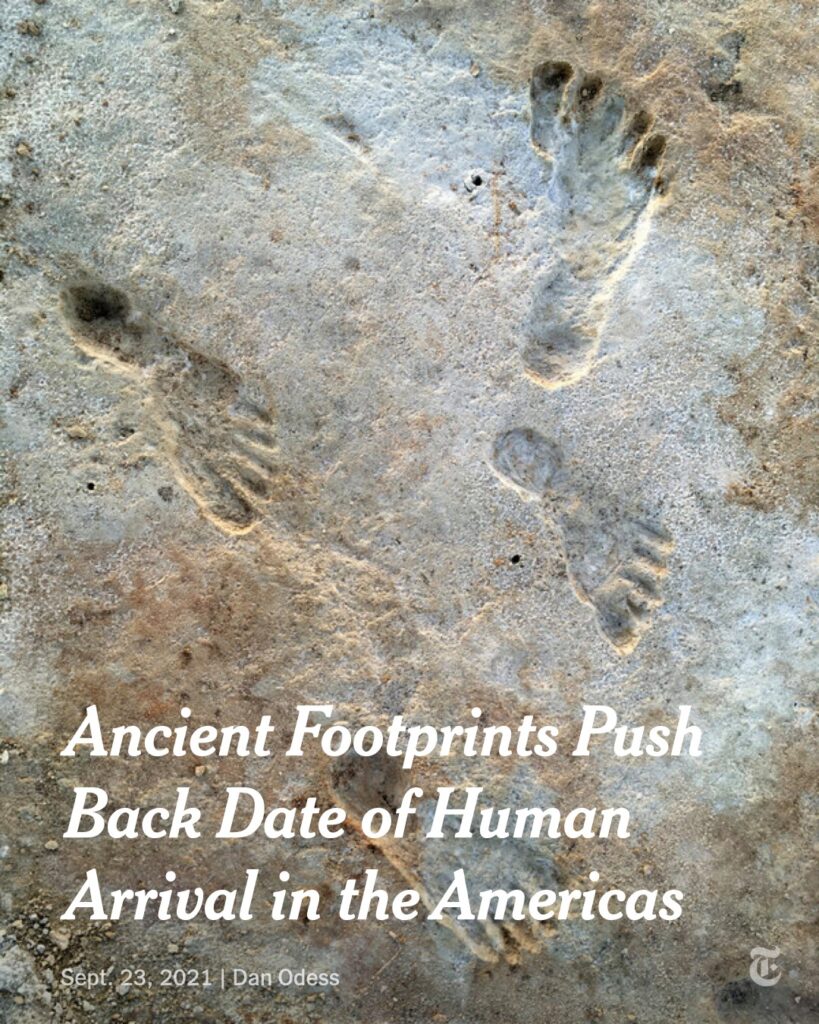
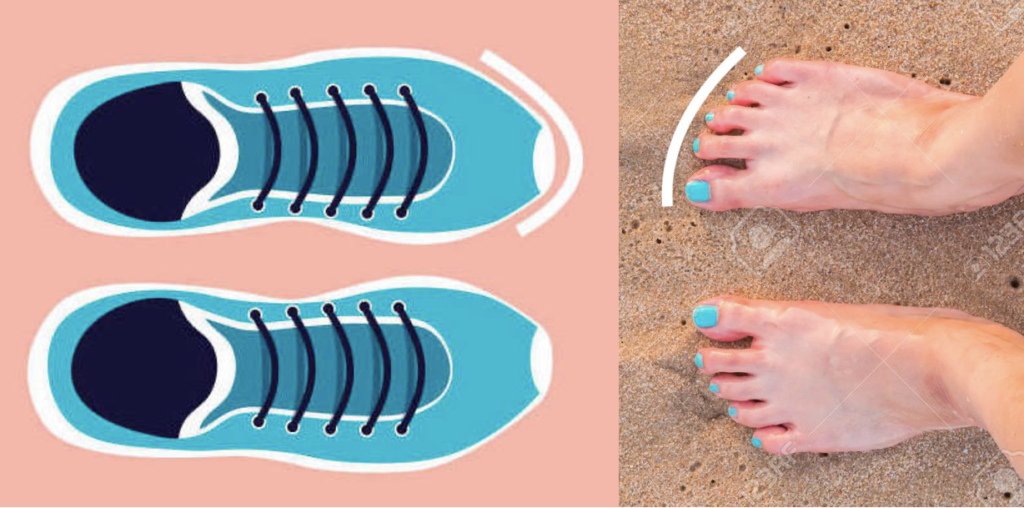
In the past, before we invented stiff and constraining shoes, our feet looked very different. Here’s a fascinating article about natural feet, and how they work when not trapped inside restrictive shoes. Our feet change as footwear styles evolve. You may feel like you need arch support or a “good sturdy shoe” because that’s what you’re used to: Your feet have been slacking off and letting the shoe do the work, so they are weak. Just like any other deconditioned muscles, they can be re-trained to be strong and supple, by doing exercises and gradually transitioning to minimal shoes.
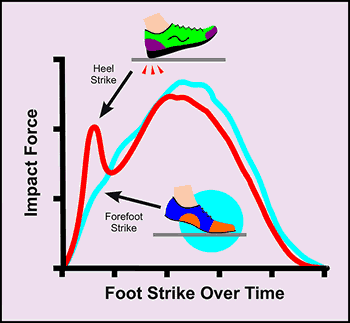
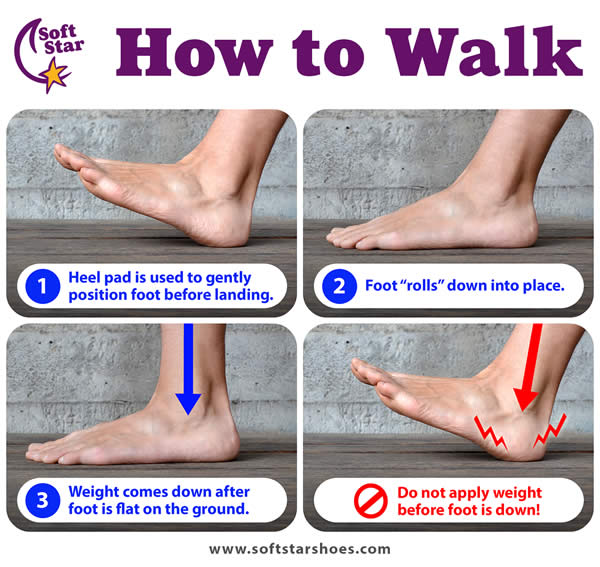
A long, long time ago, humans evolved to walk barefoot. We did just fine until we started wearing stiff, supportive shoes. Stiff shoes actually encourage a different gait – striking on the heel instead of the ball of the foot. Without the muscle of the foot softening the landing, more impact jars the body, from the ankle up to the spine.
It’s possible to retrain yourself to walk like an Egyptian (er, a pre-modern human), but it definitely takes some practice. The two graphics above are by Softstar. Their completely minimal shoes are fantastic once you have built some strength and flexibility in your feet (exercises here), but I do not recommend switching to them just yet if you’ve been wearing very stiff / supportive shoes. That’s like asking your couch potato feet to run a marathon, and injuries can happen! Note: I am a huge fan of Softstar Shoes, but they are not appropriate for everyone. If you have damage to your feet, extra weight, or spend a lot of time on concrete, you’ll need a little more support / cushioning.
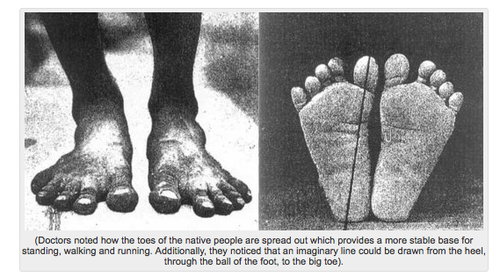
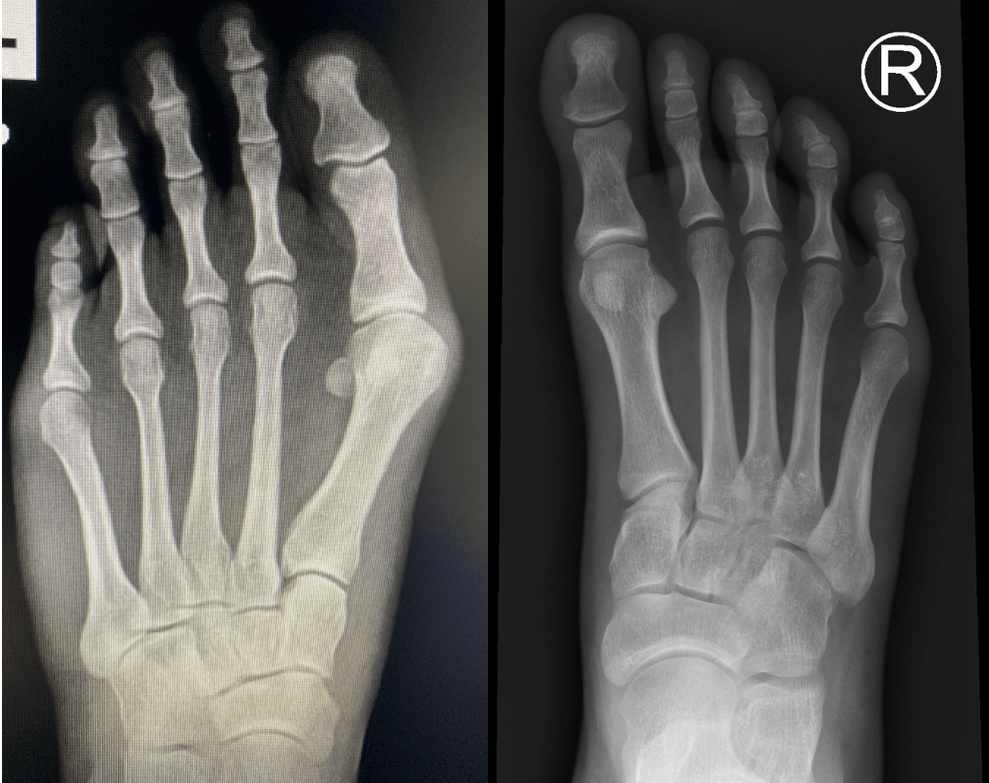
The problem is compounded because we decided to make shoes not shaped like feet, for some strange reason. Compare these pictures, and see if you can spot the problem:
Modern shoes are shaped as if our third toe is the longest, but it’s always our 1st or 2nd that need the most room. Eventually, the feet will be deformed to match the shoes. The bones of the great toe, lacking the room to reach forward, will escape sideways. I see this a lot with tall men who went through a growth spurt as a teen and didn’t immediately get new shoes.If you’ve had this problem your whole life, it’s probably due to overly tight baby shoes or outgrowing your footwear as a kid – studies of “familial” bunions that looked at baby footprints generally showed that patterns of behavior were inherited, not bad feet.
Reach down and wiggle your great toe. If it is rigid and can’t get back to a natural position, it may be too late. But if it moves, we can still retrain the muscles and tendons to get your foot back to health.
WHY THIS MATTERS– YOUR GAIT AFFECTS THE REST OF YOUR BODY!
This is not just an aesthetic issue! Your toes are supposed to be doing a lot of balancing work for you. If they are bound up, all that work gets pushed up the chain, affecting ankles, knees, hips, and even the lower back. I’m NOT saying your tight shoes caused your back pain, but they definitely contributes to a complex set of issues, and they slows down your recovery.
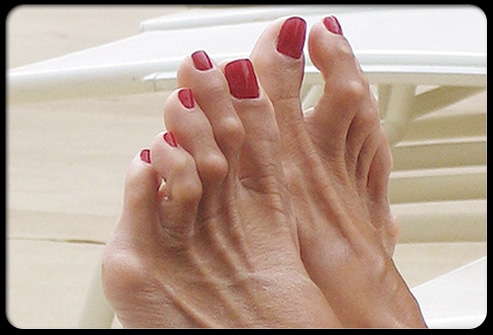
Hammertoes form for the same reason – not enough room in the toebox. After being squinched up for a while, the tendons shorten and the crimped posture becomes that foot’s default. But we can reverse that with acupuncture, medical massage to break up fascial adhesions, and gentle daily stretching.
Please let me help you liberate your toes! I can teach you self-massage, fit you for a set of Correct Toes toe spreaders, and modify them to fit you, if necessary. Of course I can also provide gentle acupuncture and advanced medical massage to get you back to optimal performance as soon as possible! :)
If you have osteo-arthritis, an inflammatory disease (Fibromyalgia, IBS, etc), or unexplained issues, listen up: There are ways to alter your diet that will help decrease your pain! It’s also very helpful when you want to reduce inflammation after an injury or surgery. Even if you don’t want to make permanent life changes, following these guidelines when you are having a particularly bad time will help.
1) Avoid sugar. This includes soda* and high-glycemic foods that will break down quickly into sugars. White bread, pasta, and starches will all contribute to inflammation.
2) Avoid fried foods. Enough said.
3) Grain-fed red meat is a problem for some people. Grass-fed meat is less inflammatory, since the fat structure is different.
4) You can counteract pain by eating ANTI-inflammatory foods. Dark leafy greens like kale and spinach will help a lot. Berries (except for goji and blueberries), turmeric, garlic, celery, pineapple, cocoa, ginger, and foods containing good fats (extra-virgin olive oil, coconut oil, avocado, salmon, nuts & seeds) are great, too. If you are sensitive to oxalates, however, be careful not to overdose on the dark leafy greens.
5) Foods your body doesn’t like. More and more, I’m seeing personal sensitivities to foods that are healthy for others. In particular, women past menopause seem to develop food allergies. This can be a delayed response, so it’s hard to recognize. Reactions to dairy or wheat, for example, are pretty common. I’ve also seen legumes, eggs, oats, soy, and even vanilla. Every body is different. Inflammation in the gut will encourage inflammation all over the body.
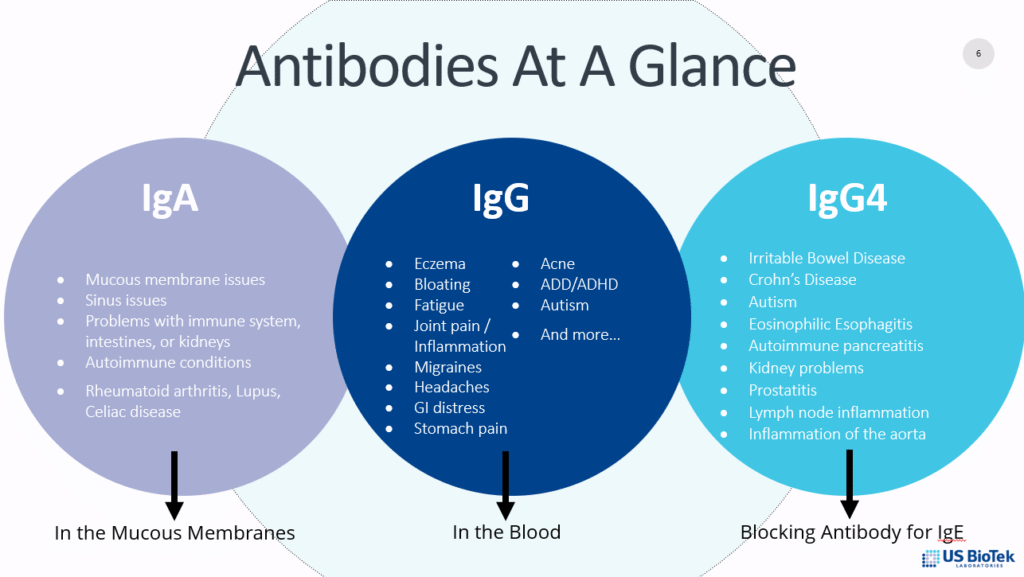
My IgG reaction, for example, shows up wherever I have arthritis. For me that’s my hands and lower back, and I very much feel the difference the next morning. This doesn’t mean you have to give up the problematic food forever! You can pick your battles, and choose when it’s worth it. The best news is that – because allergies are your immune system over-reacting to a benign substance – in some cases, avoiding a particular irritant can correct the overreaction and “heal” the allergy over time! Acupuncture helps speed up this process.
The changing, adapting nature of our immune systems also means that a test more than 2 years old should probably be repeated to identify new triggers. Most MDs only test for IgE, the deadly anaphylaxis type of reaction. These three above are more subtle, but can make you miserable.
You can skip testing and do an at-home elimination diet, but that requires a serious commitment. You can also keep a spreadsheet of everything you’re eating, and track your symptoms, to find patterns. I like putting foods down the side, and dates across the top. As I eat something, I check off the box for that ingredient and that day. Since mine manifests as joint pain the next morning, I get up and color code the previous day: White for no pain, pale yellow for a twinge, yellow for moderate achiness, red for pain. After a few weeks I could look back and see which foods were causing trouble. This is what worked for me – you should use whatever format works for you.
I now also have access to blood testing (we prick your finger in the office and send off a blood spot card) that can identify which foods you’re reacting to. It’s not cheap, but it’s incredibly helpful and much easier / faster than a thorough elimination diet. Finding out all the foods that were causing trouble has eliminated my daily pain!!
I tried going off wheat and dairy for a month last year, and didn’t see a difference, so I went back to them. It turns out I was also having an inflammatory reaction to eggs and oats, which were my usual two breakfast options. Cutting them all out (in addition to the nightshades I had already banned) made a stunning difference. In three days, my extensive joint pain just evaporated. I’m pain-free for the first time in decades! I’m NOT saying everyone needs to avoid all these foods: This was how my body was reacting. You may have fewer allergies, or none at all.
After two months of eating a strictly anti-inflammatory diet, I had a weekend camping with friends, full of wheat and dairy, and still felt great. The pizza I had Sunday evening pushed me over the edge though – Monday morning my hands and lower back were definitely speaking up. I expected that would happen, and made a quality of life choice to enjoy that pizza! And yes, it was totally worth it.
6) The Nightshade (Solanaceae) plants contain a small amount of an alkaloid toxin called solanine. Some people aren’t bothered by it. Other people, especially those with auto-immune issues & arthritis, tend to be sensitive to this family of plants. Most are unaware of the pain they are causing themselves, because they eat them so often, and because the inflammation & ache are delayed up to 24 hrs.
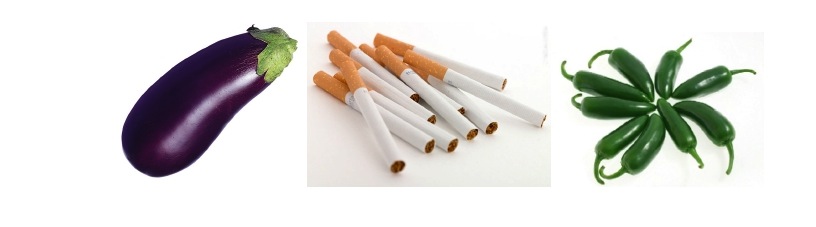
Tomatoes Potatoes (Sweet potatoes and yams are ok) Peppers, including spicy, chili, and bell peppers, and paprika (Black, white, and green pepper is ok- it’s actually a peppercorn. Long pepper is ok, too.) Eggplant Tobacco
Although less well known, Goji berries and gooseberries are nightshades, too.
Note: Blueberries, huckleberries, artichokes, cherries, apples, sugar beets, and okra are not in the Nightshade family, but they also contain solanine.
The good news: It’s very easy to find out if you are Nightshade sensitive. Simply remove all of them from your diet for two weeks You’ll have to read labels carefully. “Spices” may contain paprika, and lots of prepared foods like shredded cheese can contain potato flour, labelled as “cellulose.” After two weeks of avoiding them, have a big dose. Enjoy that eggplant parm with marinara sauce, a pile of potatoes, or drink a V8. See how you feel that evening and the next day. If within 24 hrs your pain is worse, you are Nightshade-sensitive. Wherever you have inflammation, that’s where it will show up. If not, congrats – you can go back to all the tomatoes you want.
The alkaloid is degraded by extreme heat. Deep-frying will destroy solanine … but fried foods are inflammatory for other reasons, so don’t get too excited. I will eat a small amount of potato chips on a special occasion because they are fried all the way through, but not french fries, since they are still squishy in the middle.
The combination of Nightshades and sugar is a doozy. I can get away with a small amount of tomato paste, but even a tiny squirt of ketchup used to make my hands ache the next day.
Following an anti-inflammatory diet is a relatively simple way to decrease your pain and make a real difference in your quality of life. Some people have inflammatory reactions to dairy or wheat, and that may be worth testing the same way as the Nightshades. You don’t have to be perfect all the time – just make conscious choices.
Spicy food junkies: Fear not! You can still enjoy horseradish & wasabi, onion, garlic, ginger, and all the peppercorns, including long pepper.
Here’s a nightshade-free curry recipe and one for NonNightshade Mexican. Substitute either cauliflower or sweet potatoes for regular potatoes. Pizza and pasta are great with pesto sauce. There are wonderful southern vinegar-based BBQ receipes. There’s even a “No-Mato” marinara sauce I found online (OMG SO GOOD!!!! I used the higher levels of spice for everything and loved it! If you use all regular beets it’s purple. If you use 50% regular beets and 50% golden beets, you’ll get a red sauce with a less “beety” taste. Freezes well, too!).
UPDATE: Now that I’ve been Nightshade-free for a while, my sensitivity has decreased drastically. There seems to be a cumulative effect. By staying away 99% of the time, and preventing a build-up of inflammation, you can enjoy the occasional indiscretion. This is more and more true as time goes on! Now, I can “cheat” about once a week without effect. I can even indulge in big naughtiness once in a while. Be patient!
*Diet soda isn’t a good solution. While it doesn’t contain sugar, the artificial sweeteners cause their own problems, including triggering the body to start storing more calories as fat.
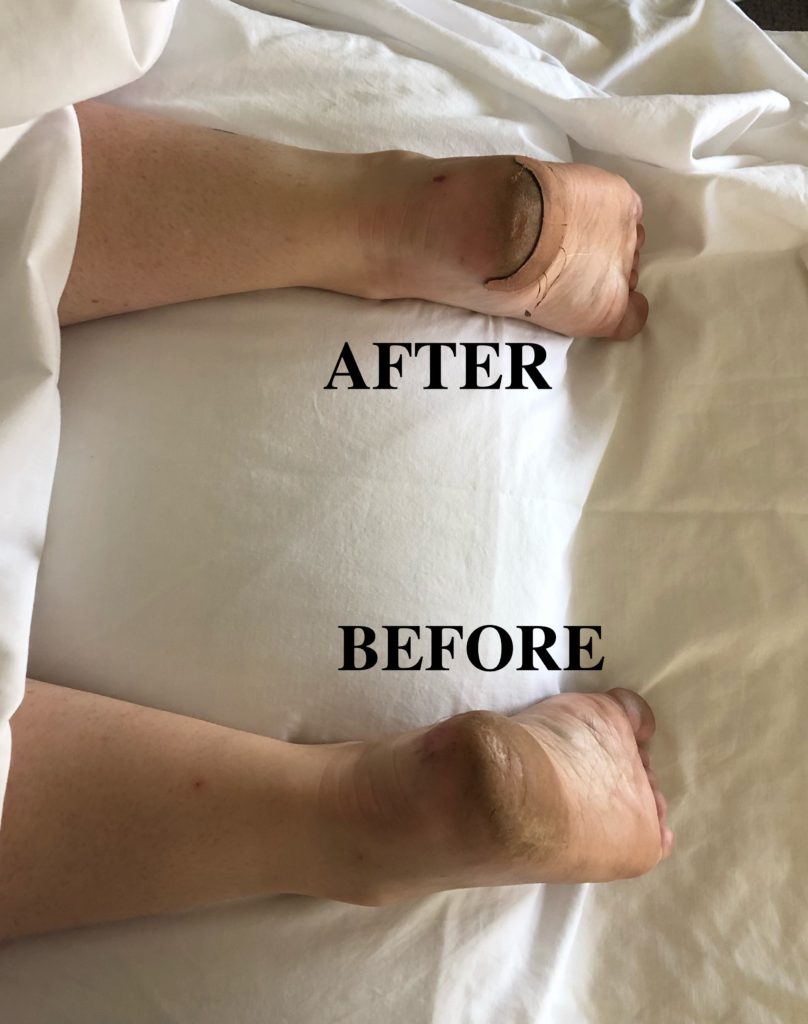
A patient came in today with lower back pain. When she got onto the table, I saw this familiar pattern: Take a look at her ankles. Before I started work, both of them looked like the “before” (left) side. This tendency for the foot to turn in is called “ankle supination.” It can be caused by many things, but in her case she had some fascial adhesions on the medial (inside) ankle.
She’s lying face down on a table with a pillow under her ankles. Notice the curvature in the left (before) ankle.
The way our feet strike the ground affects the entire chain … the ankle, the knee, the hips, the back. In extreme cases, a dysfunctional gait can even affect your neck! I knew I needed to address her ankle supination for long-term back improvement. Having canted ankles can also contribute to more foot movement inside the shoe and create blisters / calluses.
After acupuncture to treat her back pain, we did some medical massage. I reset the the function of her back muscles and finished with some myofascial release on the medial ankles. After I worked on the left, the difference was so striking I wanted to share it. Of course after I snapped the evidence pic, I went on to correct the right ankle, too.
When she stood up, she felt good, but a little unsteady. This is normal – she was used to the adhesions doing the work of stabilizing for her. I instructed her to go for a little walk. Now that the musculoskeletal system is corrected, light movement will provide feedback between the brain and muscles. They will reintegrate, and start doing the supporting they’ve been neglecting. Typically, at the end of this walk my patients tell me they feel terrific!
Sit or lie down and take a look at how your feet are aligned at rest. Do they curve in (ankle supination)? Out (ankle pronation)? Or maybe just one is crooked? If the answer to any of those is yes, come see me, and let me help you straighten out your gait! :)
I’ve talked about fascia before in this blog, but I wanted to expand on the topic: It’s SO important, causing so many resolvable issues. It’s frustrating to me that fascia is unknown by average people, and ignored by so many types of healthcare practitioners. It’s ESSENTIAL in understanding biomechanical dysfunction and healing.
Fascia is the connective tissue that – literally – connects all of our parts. It’s why we are up walking around instead of a pile of organs and bones on the floor. These delicate layers of tissue are supposed to move past each other inside us as we move, but sometimes they get stuck. Trauma like injury or surgery, or a sedentary lifestyle over long periods, are frequent causes of fascial adhesions.
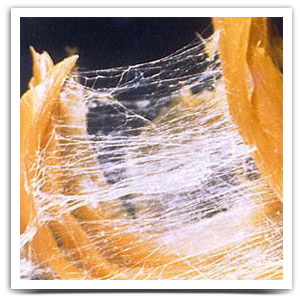
Once I bought a rotisserie chicken from a regular grocery store. As I was taking it apart, I was stunned at how bound up the bird was, compared to the free-range chickens I was used to. A lifetime of forced inactivity had created fascial adhesions all over – you know, that translucent white sheeting? The muscles were all shrink-wrapped in place. “This poor chicken needed a massage!” I told Robert. I felt so bad for it. Just another lesson on how important light, frequent movement is for our bodies.
Connective tissue / fascia (white) and muscle fibers (tan)
Tight fascia will pull on our muscles and bones, preventing free movement and potentially causing misalignments. In severe cases, it can constrict nerve and blood vessel function, creating swelling, pain, or numbness & tingling.
Resolving fascial adhesions is as simple as knowing the right medical massage technique, myofascial release. I can do it for you, and I can show you how to treat yourself and your loved ones.
For hard-to-reach areas, you can use a foam roller to soften the adhesions. I advise people to use it against a wall, rather than lying down on it, because you can control the pressure better. Remember you do NOT want to cause intense pain – that will spark an alarm response. The body will think you have a new injury and will send sticky connective tissue to glue up whatever is torn or bleeding – which means the adhesions you just broke up will reform themselves. It’s best to use the roller gently, then move. Go for a walk or do your usual workout. Movement will help release those weakened adhesions.
Likewise, those home massagers and thumpers can be helpful, but I recommend you use the lowest setting, and don’t go for more than 10 minutes.
Want to learn more? There’s a treasure trove of articles here.
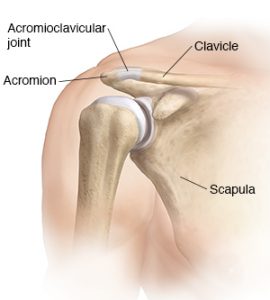
Anterior view of shoulder joint with muscles. SOURCE: Based on AMuscsk_20131017_v0_001.
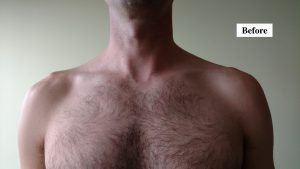
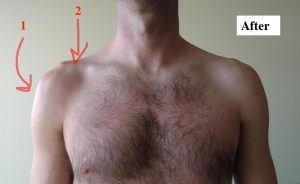
This 40 year old gentleman separated his acromioclavicular joint 2 years ago, in the April of 2016. Since then, he’s had shoulder pain and a lot of crunching noise with movement.
I treated him with acupuncture and medical massage. The goal was to break up fascial adhesions (scar tissue) and his muscles working properly again.
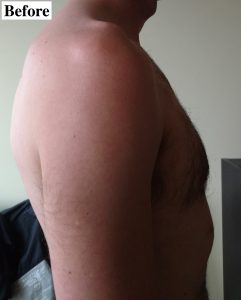
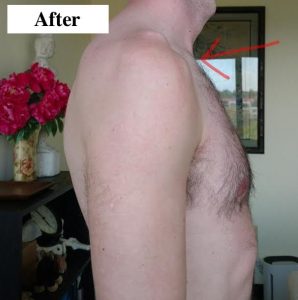
These pictures were taken on 4/3/18 and 4/25/18. He received 4 sessions of care.
First, look at the outside curves of the shoulders. He is much more symmetrical in the after pic. His deltoid (“shoulder cap” muscle”) has filled out now that he’s using it. Secondly, the shoulder girdle is no longer being held
forward. See the difference in the shadow at Arrow 2? And the A/C joint isn’t sticking out as sharply.
Here in the side view, you can see how the shoulder has rotated back to its normal position. In the Before pic you can’t see his chest at all at the top. His scapula (shoulder blade) is also sticking out in the Before shot.
Most importantly, the patient reports less pain, less crunching, better range of motion, and generally better performance. :)
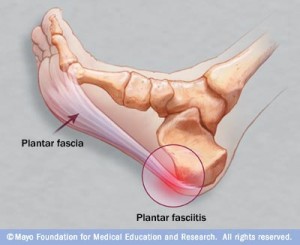
Plantar fasciitis is a painful condition that makes your feet hurt, especially with the first few steps after being off of them for a while. What’s happening here? First, we have to understand fascia. It’s a system of connective tissue that holds us together.
Connective tissue (white) and muscle fibers. In plantar fasciitis, those fibers get tight and brittle.
It may help to picture a muscle fiber as a new drinking straw in a paper wrapper. The straw is actually the muscle cell, while the white paper is fascia. At each end, that flap of fascia becomes our tendons. It attaches to bone – or, more precisely, to the fascia surrounding bone. These sheaths of fascia are supposed to slide past each other as muscles move. With long periods of no movement, if the muscles are tight, or if there’s an injury, they can stick together and form a fascial adhesion.
When the plantar fascia (the fascia on the bottom of the foot) doesn’t move, it gets stiff and brittle, causing plantar fasciitis. When you do move, it hurts like crazy! The immediate answer – the one most old-fashioned podiatrists give – is to stop the movement. They prescribe stiff orthotics and walking-boot-type shoes that prevent your feet from flexing. That approach does give short-term relief, but in the long run it just sets you up for more pain.
Instead, advanced podiatrists like Dr. Ray McClanahan recognize that our feet evolved to be mobile. For millennia, they were a wide, stable base for our bodies that responded to uneven ground. Most modern footwear is too stiff and constricting, which restricts both toe movement and foot flexing, and reduces us to balancing on a solid block. The best long-term fix for plantar fasciitis is to get things moving again!
The entire bottom of the foot can hurt, although pain is usually focused in the heel.
2) Strengthen the feet with exercises (more here!). The muscles that create the arch of your foot are actually in your lower legs (they have long tendons down to the bones in the foot). Myofascial release for your legs will be helpful, too. With a little work, your legs and feet will support you as nature intended.
3) Break up the adhesions in the feet, using any combo of myofascial massage, acupuncture, rolling with small balls, etc. You have to do this a little bit at a time. Some people like to get in and dig the adhesions apart, deep-tissue massage style. That works well in the short term, but it also causes inflammation… which causes scar tissue and fascial adhesions to form… putting you back where you started. Myofascial release uses a more subtle massage approach to slide the layers apart. I love doing this type of work because the result is immediate freedom of movement and no boomerang side-effects.
The bad news: This is the only treatment I do that hurts.
The good news: It stops hurting immediately, and the relief is powerful and swift.
NOTE: This is how to treat the underlying problem – stiff fascia. If you are in a painful flare right now, we need to treat the “hot” injury first. That means (just as with any tendonitis) rest, ice, acupuncture and anti-inflammatory help via the diet or a topical medication.
Come see me and let me treat your plantar fasciitis. Won’t it be nice to go for a walk without pain again? I’ll be happy to help you assess your current shoes (sometimes there are tweaks we can make to give you more space in them) or pics of those you are considering on the internet!
I often have patients come in with a “mysterious” chronic lower back pain. Sometimes it’s described as lumbar or hip pain. They’ve been to doctors and chiropractors, but it still persists. As soon as they put their hand on it (low and to the side, where the buttocks meet the back) it’s pretty clear that the problem is the SI – the sacroiliac joint.
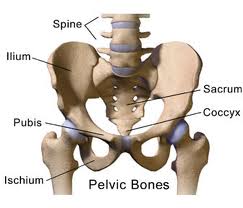
The SI joint – where the sacrum meets the ilium – is a long vertical area on the sides of the lower back. Back pain is often centered at the top of the SI joint.
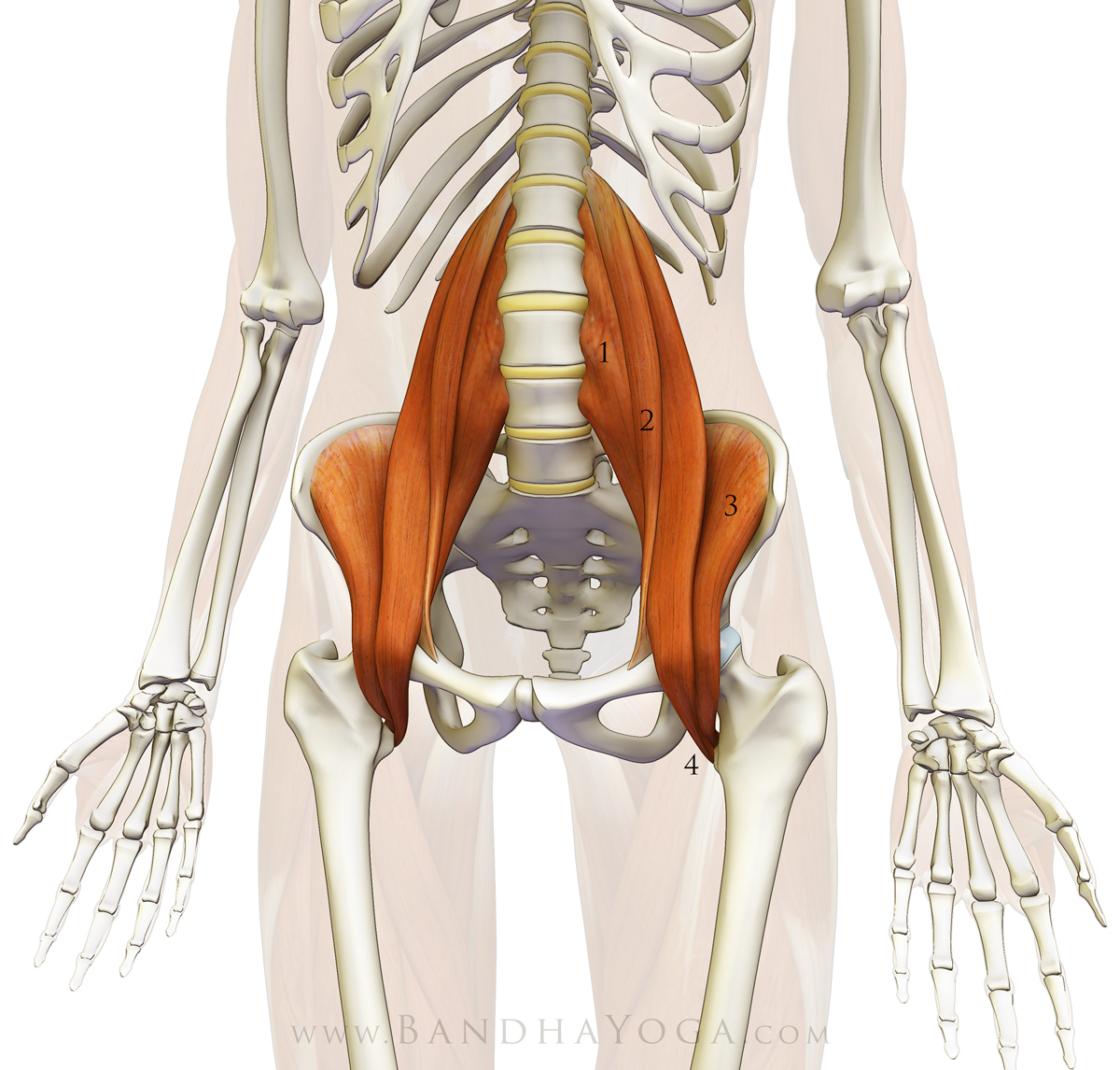
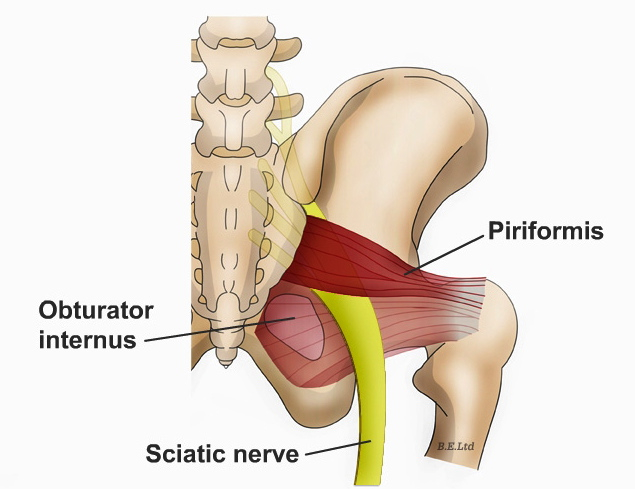
At the bottom of your spine is a triangular bone, the sacrum. Attached to that is your pelvis (made up of the ilium, ischium, and pubis). Your femurs, the long bones of your thighs, settle into a socket on the side of the pelvis. A complex set of ligaments and lots of muscles join all these bones. If one or more of these muscles is tight, weak, or spastic, it can throw the balance of the entire pelvic system off. A few of the major players are Iliopsoas, piriformis, and quadratus lumborum. These muscles keep us upright and help us walk, but when they go bad… I call them the Holy Trinity of Lower Back Pain.
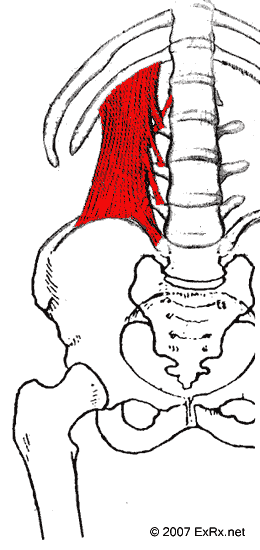
Quadratus Lumborum runs from the lower ribs to the top of the ilium. There are also connections to the spine. This is your “hip hiking” muscle – imagine a “belly dance” sort of motion – but if course it’s essential in walking and other daily movements.
Iliopsoas starts at the front of the spine and the ilium, goes through the pelvic cavity, and attaches to the femur. It gets tight on people who sit a lot, particularly if you are tense while sitting (motorcylists and people who hate their jobs). When tight, it jams the bones together and creates stress on the joints.
This is a back view. The piriformis muscle attaches at the sacrum, and goes across the butt to the femur. The sciatic nerve passes under it or through it, depending on your personal anatomy. When the piriformis gets tight, it squishes the sciatic nerve and can cause electric shocks or pain running down the leg.
With every step you take, the sacrum “nutates” – it tilts back and forth in relation to the ilium. If the bones are jammed together and can’t glide properly, it causes pain. Sitting can also be a painful prospect: If the joint is inflammed, the altered pressure of a seated position can be excruciating. I understand this very well because I developed lower back pain and SI problems along with a L4-L5 disc herniation after my car accident in 2001. I wasn’t able to sit at all for the 6 months before I discovered acupuncture and Osteopathy.
There’s rarely only one muscle involved. Usually a primary dysfuction causes a cascade of compensation with other muscles. Nerves can be pinched by either tight muscles directly or by a bone pulled out of place by a tight muscle (bones don’t move by themselves). Nerve impingement can lead to pain radiating down the leg or into the genital area. Motor control as well as sensation may be affected. The leg may go weak, or a patient may experience bladder or bowel incontinence (If this happens, get to the ER immediately – they will take steps to relieve pressure on the nerve and prevent permanent damage).
In most cases, the first thing we have to do is reset the tension on the muscles. Acupuncture and medical massage will work wonders here. Once the soft tissue is corrected, I can generally realign the bones with fingertip pressure. They just slide back home with no drama or fuss. Now it’s a matter of allowing the irritated nerve to calm down, which can take 20 minutes to months (or never, in worst-case scenario), depending on the extent of the damage. Whenever you are dealing with entrapped nerves, it’s important to get care immediately. Releasing them quickly gives you the best shot at a full recovery like mine. Getting the pain knocked down allows you to rebuild. Rehabilition exercises and stretches (plus some myofascial release) will make your muscles strong and supple again, so they work properly, which will keep your bones in the right places. I no longer have any back pain, and I’m back in the gym doing heavy workouts including Romanian deadlifts!
Last month I mentioned that I was having some trouble with my Arnica distributer (problem resolved – it’s in stock and ideal for bruises, sprains, and strains). I found a fantastic solution: Hai Tong Pi Tang. This is an ancient Chinese anti-inflammatory formula, containing frankincense, myrrh*, saffron, and a number of other herbs. The tincture is in an alcohol base, and made by a local acupuncturist. It comes in a spray bottle, so you can easily apply to any injured or inflamed area. External use only, and not on broken skin, please!
Here’s a fun bonus: The aromatic herbs combine to create a “pancake” scent. Much nicer than Ben-Gay or the usual herbal stinkiness! Watch out, though, you might get nibbled on by fans of maple syrup. :) 2oz bottle for $25.
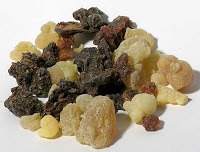
Frankincense resin – anti-inflamatory, anti-bacterial, and calming.
*Frankincense and myrrh have been “Moving” herbs in the Chinese pharmacopia for thousands of years. They are used to treat “stagnation,” which translates to muscular stiffness and pain, among other things. I was once on a cross-country flight when my back seized up. This was early in my acupuncture schooling, while I was still recovering from a traumatic car accident. Somehow I had neglected to pack any anti-inflammatory medication, and the flight attendants weren’t allowed to give me any. I was in so much pain, and I had hours left in that horrible seat! Then I remembered that I had brought along my herb samples to study for an identification test the next Monday. I ate the frankincense and myrrh samples – something I DON’T recommend, as they taste terrible! – and within 20 minutes my pain was gone. I’ve been a big fan ever since.
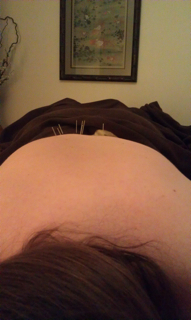
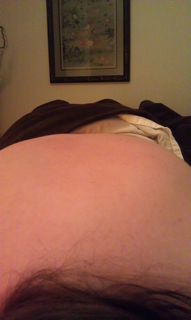
I usually forget to take Before and After shots but will try to make more of an effort in the future. They are so much fun! Here, we are looking along the patient’s back, from the head towards the feet. She came in with upper and mid-back tension. I found a series of 4 ribs out of place on the right side. After some gentle acupuncture and medical massage, everything was back where it should be and she was thrilled to find that she could take a deeper breath than before.
BEFORE – note the slope of her asymmetrical posterior ribcage.
AFTER – now her ribs are properly positioned, her back is even, and she can breathe more deeply!
Jian Jing (Shoulder Well) is a place many people tend to store their stress. Every day, people come into my office and complain about neck and “shoulder tension.” They really mean the trapezius and levator scapula muscles, not the shoulder joint. I’ve been saying for years that we need a better name for this part of the body, but “noulder” isn’t catching on (for obvious reasons!).
Referred pain and trigger points for the trapezius.
The trapezius is a big muscle, and it does a lot. Carrying heavy loads (especially unbalanced ones – so carry a small purse and use both straps of your backback!), working with your arms up (I’m talking to you, hair stylists!), or just general hunchiness over a computer… all are common causes of tension. The traps refer pain over the head to the eyebrow area, so shoulder tension can give you a severe frontal headache.
GB-21 also descends energy, so it’s good for rebellious rising Qi causing headaches, dizziness, heartburn, or vomiting.
GB-21 for relieving neck and shoulder tension.
Find GB-21 at the top of the upper thoracic area (aka “noulder”), halfway between the shoulder joint and the spine. Press firmly for 10-15 seconds with a healing intention. NOTE: Do not use GB-21 on pregnant women.