Chiropractic, a second look

Many D.C.s are great. If you are seeing a chiropractor and have had good success, fantastic! I am the last person to interfere with something that’s working. But if your “genius” has been “fixing” you for years and you are still the same as when you started… it might be time to rethink chiropractic.

Sure, you get temporary pain relief and a nice endorphin rush… but does it last? And is there a cost?

I am NOT a fan of the subset of chiropractors who indiscriminately and overzealously use HVLA adjusting (high-velocity, low amplitude – you know, that violent cracking). Low-force chiropractic like Network, BGI, and activator is absolutely safe, and there are lots of other techniques besides HVLA that are fine. HVLA is appropriate when used to correct an acute injury, like putting a dislocated shoulder back in the socket, but it should not be a frequent therapy. Repetitive stress of supportive ligaments and the resulting inflammation will actually damage the joint.

My information comes from my time at chiropractic school (I completed the first year, including the entire series of cadaver dissection, with nearly straight A’s), my knowledge of functional anatomy as a certified personal trainer and amateur bodybuilder, my 10 year partnership with an Osteopathic medical doctor, my experience seeing patients who have been damaged by repetitive HVLA, and discussions with many physicians of all types. I welcome input from any chiropractor who is interested in a fact-based discussion.

Personally speaking, I suffered a terrible injury when my car was broadsided in the first week of chiropractic school. Their treatments were making me worse, and the more I learned in school, the more I understood why.

1) It doesn’t treat the cause of the problem. Bones don’t move by themselves. If a bone is repetitively out of place, it’s because there’s a tight muscle pulling it that way, or a weak muscle failing to hold the bone in place. Jamming the bones back will cause micro-tears of that tight muscle. It feels good immediately, because you get a nice adrenaline rush along with your temporary fix. An enlightened chiropractic teacher compared HVLA to the shock and rush you get from a shot of vodka. Addicting, but not necessarily good for you. Unfortunately, as soon as the muscle goes back to its usual tight, spasming self, the bone will be pulled back out of alignment. That’s why you need to go back to the chiropractor the next week. Acupuncture and medical massage use the neurological system to retrain those tight muscles, so real healing can begin.

2) Our ligaments and tendons are there for a reason. They provide much-needed joint stability and hold us together. Repetitive HVLA weakens them, and can destroy your joint integrity. We all know that an ankle, having been sprained three times, is pretty much guaranteed to twist again. You do not want that floppiness in your spine. You should not able to crack-crack-crack your back simply by stretching. That’s called hypermobility and it means you can move too much. If you have already been damaged by too much HVLA, you will need to strengthen your back and abdominal muscles to help support those loose ligaments and tendons. Hypermobile backs are more likely to suffer a serious injury if you have an accident (this is what happened to me!).

3) Your reflexes work against HVLA. Quickly yanking on a muscle – even a relaxed one – can cause damage and inflammation. There’s a built in protective reflex that tightens a muscle when it is suddenly lengthened. You can feel this: Fold your friend’s arm at the elbow and put your hand on their bicep. Straighten the arm quickly, and you can feel the bicep twitch under your hand. Now imagine that happening to an already-sore neck muscle being snapped.

4) The pop means nothing. The cracking sound doesn’t necessarily mean you’ve been adjusted properly. It’s called cavitation, and it means that nitrogen gas, naturally occurring in your joint fluids, has been released. A similar thing happens when you open a can of soda. The sound means the bones have been rapidly separated (opening the joint space) and then have come back together. They may have come back to the same position, a better one, or a worse one. Misalignments, when corrected gently OMM style, do not make a cracking noise because the joint space is eased into the correct position rather than violently forced.

5) First, do no harm. Some chiropractors don’t bother to diagnose which level is dysfunctional. They just “shotgun” you by cracking all the vertebrae in your spine. Then they flip you over and do the other side. Why cause stress and create inflammation in a joint that’s working? Added bonus: Whenever you have inflammation, scar tissue forms. Trauma (HVLA) every week leads to more and more scar tissue building up. That’s the last thing you need when you’re already hurting.

6) With repetitive strong adjustments, your body becomes dependent on that input. In chiropractic school we joked about “welfare spines.” I had a discussion with an instructor who was brutally blunt about the temporary nature of his treatments. “Of course they have to come back. That’s how you buy your boat.” I found that model of “medicine” distasteful and unethical. I prefer to help the body heal itself. I love acupuncture and OMM because they truly correct how your muscles function.  Combined with proper exercise*, this creates a body that is strong and capable of bouncing back after a minor injury. I don’t want to see you every week for the rest of your life. I’d prefer to get you better and self-sufficient, and then stay in business by fixing all your friends and family. :)

7) Some chiropractors think that HVLA is “the only way to reset a nerve.” That may be their only tool, but I can reboot the nerves that control muscles with acupuncture, Still, counterstrain and Sotai techniques. These last three are advanced medical massage methods that are easier to explain in person – ask me when you come in!

BTW:  “But I can’t help it!” When you are out of alignment, your body will naturally feel compelled to snap itself back in place. After my injury I used to violently crack my neck and back all the time. It never really solved the problem, though… refer to point 1 above! The good news is that the desire to self-adjust melted away when my muscles – and more importantly, the neurons controlling those muscles – were corrected by acupuncture and Osteopathic medical massage.

*Exercise is essential to strengthen weak muscles, remind tight ones how to relax, and get all your muscle fibers integrated and working together. We are built to move! I know firsthand how pain makes you want to curl up on the couch and wait for it to heal, but the hard truth is that it won’t really repair until you put in the work. Get on an anti-inflammatory diet, see me for basic physical therapy-type exercises, and start walking! Better yet, see an expert personal trainer.

BL-40 (back pain, knee pain, hot flashes)

BL-40, Wei Zhong (Middle of the Crook), is located in the center of the back of the knee. It’s the Ruler of the Lower Back, so I often use it to treat lumbar problems. It’s also great for deep knee pain and to cool the Blood* – try it if you’re overheated next summer, or if you’re suffering from hot flashes. Other good points for lower back pain: LV-3, GB-34, Du-4.

BL-40, the Ruler of the Back.

*Remember: The Chinese concept of “Blood” is different from your physical blood. I am not talking about your literal circulatory system. :)

GB-34 (any muscle / tendon issue, knee pain, Damp Heat)

GB-34 is Yang Ling Quan (Yang Mound Spring). The name refers to its location on the Yang aspect of the leg. GB-34 is the Ruler of the Sinews (musculoskeletal system), so it will treat muscles, ligaments, and tendons anywhere in the body. It’s particularly effective for knee problems, due to its location. GB-34 can also be used to treat issues like jaundice, nausea, and vomiting. It’s also good for treating Damp Heat, but that’s a fairly complicated Chinese medicine concept related to infection. Ask me if you’re curious.

GB-34 is about an inch anterior and inferior to the head of the fibula. First, find the head of the fibula. This is a knob of bone on the side of your leg,  just below the knee, towards the back. Now slide your finger forward and down into a small dip. It will be tight or tender if treatment is appropriate: Press firmly for 20-30 seconds, with healing intention.

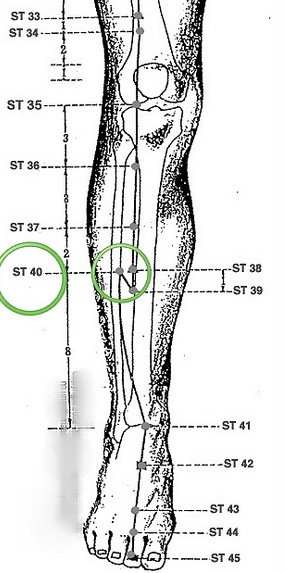
ST-40 (phlegm, wet cough, foggy head)

ST-40

Feng Long is a great point for draining phlegm. Use it when you have a head cold, wet cough, or allergies . Find ST-40 halfway between the knee and the ankle, on the outside of the lower leg. Feel around for a sore spot: You’ll know when you hit it. Press firmly for 10-15 seconds. It’s great for “visible” phlegm, the obvious mucus stopping up your nose and lungs. It’s also useful for “invisible” phlegm, the kind that clogs up your brain and leads to dizziness, vertigo, “foggy headedness” (fuzzy thinking), or mental illness.

ST40

Yin & Yang

*Note – some parts of this discussion were previously published in the Stroke article.

Chinese Traditional Medicine (TCM) goes back to 2000 BC in its current form, and in its antiquity goes back at least 5,300 years! It’s based on energy movement throughout the body along specific paths or “channels.” Acupuncture works by manipulating energy at points where that energy flows near the surface. There are about 1000 distinct points all over the body, each with their own unique qualities. I came to acupuncture as a profession when it was the only thing that could stop my back pain after a severe car accident (I’m now completely recovered). When I first started studying I was a little skeptical – I was a hard-core scientist and figured the map of channels was an elaborate way to memorize nerves and other anatomical landmarks. The more I studied, though, the more I came to see that this is a completely different system of physiology.

After years of seeing the power of this odd system at work – on skeptical humans, on animals, on “impossible cases” – my current belief is that this is a form of energy we just can’t explain yet. If you told a 16th century doctor that you could see inside the human body without cutting it, you would be declared a witch. Now, any x-ray or ultrasound technician has that ability. NIH has been funding research into measuring energy flow along the channels. It’s only a matter of time before TCM becomes part of our accepted science of medicine.

We’ve all heard of Yin and Yang (pronounced to rhyme with Pin and Pong, by the way). They are tossed around in popular culture a lot, generally with a superficial understanding of them as two sides of a whole. I’ve even seen them likened to Superman and Clark Kent! In Chinese medicine, however, they have a very specific meaning.

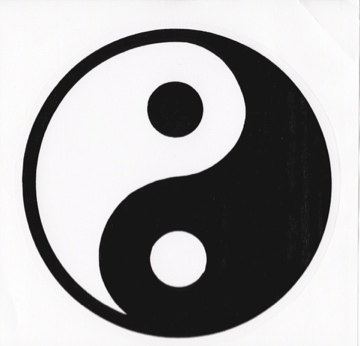
Think of Yin as being the moist, nourishing, quiet, still, internal, “feminine” aspect of your being. Yang is the other side of the coin: It’s the loud, bright, moving, motivating,expanding, “masculine” side of you. See how the white Yang is rising, while the black Yin is descending? Note also that each contains a bit of the other: They are incomplete without the other half of the pair. There is a delicate balancing act between the two types of energies, and they influence each other. When Yin and Yang separate (in a raging fever, for example) the patient will die.

Yin/Yang: Each contains and is dependent on the other to create a whole.

Think of an animal, or a baby crawling on all fours. As applied to anatomy, the front and lower parts of the body are Yin. The back and upper body are considered more Yang.  On the limbs, inside surfaces are Yin and the outside aspects are Yang. Acupuncture treatments must be planned out so they contribute to balance. For example, if someone has a headache, we don’t just use local needles on the scalp. We use points on the hands and feet to distribute the input to the body. There’s a great point on the sole of the foot that will draw excess energy down, which helps a lot with Yang-rising types of headache.


Yin and Yang energies must work together, and should give and take throughout the day. Yin predominates at night, while Yang rules the day. Some hormonally based examples may be helpful: A woman going through menopause is Yin deficient. Her Yang, no longer held in check by her Yin, causes hot flashes, night sweats, and dryness of the skin and other bodily fluids. To ease this “change of life,” we start by using acupuncture points to clear excess heat (the symptoms). Other points act to nourish the Yin (the cause). These treatments are surprisingly powerful for stopping hot flashes.

Likewise, a man as he ages will suffer from Yang deficiency. This is readily identified in the case of erectile dysfunction and decreased libido. Other symptoms can include lower back pain and a general loss of vigor.  In this case, we use acupuncture points that activate the Yang. Some acupuncturists use moxabustion (burning mugwort, an herb in the sage family) to warm and stimulate the Yang, although most modern clinics (mine included) are now using infrared heatlamps. Using modern technology eliminates the chance of burns and makes for a wonderfully relaxing session.

Most patients feel some immediate relief when acupuncture is used to balance Yin and Yang, but longer term hormonal changes will require multiple treatments.

This is a simplified explanation, of course. Masters of Chinese medicine study for years to understand the subtle interplay of Yin, Yang, and the channels. It’s a fascinating tradition with a lot to teach us about the human body.

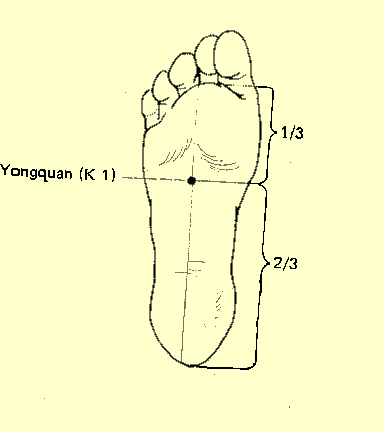
KD-1 (emotional grounding, headache)

Yong Quan (Gushing Spring) KD-1 is located on the sole, about an inch below the “butt cheeks” formed by the ball of the foot. It descends energy, so it’s great for treating some types of headaches, gastroperesis, and acid reflux. It also grounds the patient emotionally and supports the Kidney (Remember, the Chinese energetic organ called the Kidney is not the same as your anatomical kidneys). The Kidney stores your Essence and is associated with the emotion of Fear, so this is a doubly good point to use for PTSD or other issues with being afraid. Of course it’s also useful for plantar fascitis and other foot problems. Press firmly for 20-30 seconds, with a loving, healing intention.

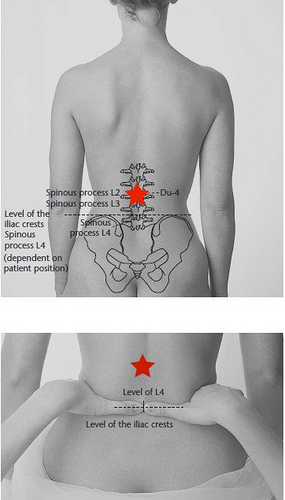
Du-4 (warm the Yang, lower back pain, low energy, infertility or ED)

Mingmen, the Gate of Life (AKA Du-4) is located in the center of the spine, just below the 2nd lumbar vertebrae. It’s used for building Yang, treating infertility or sexual issues such as erectile dysfunction, and for lower back pain or weakness.

Be careful stimulating this point if you are using acupressure, since it’s often tender.  Applying heat can be useful, especially If you tend to be cold. In my clinic, of course, I use acupuncture and an infrared therapy lamp. At home, you can direct a warm shower stream onto it or use a microwavable rice bag (I have them at the office if you need one).

Also good for lower back pain: LV-3, BL-40 and GB-34.


An ideal world

Do you know what you would do with your life, your career, your romantic situation in an ideal world? Do you have that mental list of things you’ll do when things get
better? Calm down? Settle? You know, life will be so much better when things get organized, when the student loans are paid, when the health scare passes, when the kids get just a little bit older.
It’s easy to think about what we would do “in an ideal world.” Unfortunately, such a world does not currently exist. That much is obvious, even to me. What’s less obvious, though, is that the ideal world will never actually exist.
We like to think about that because it gives us hope. Life as we know it is usually so crazy and stressful that we need hope to hold on to, if for no other reason than to believe that
life won’t always be like this. The trouble is, life will always be like this. If it’s not like this, then it will be like that – there’s always something! If things calm down in one area, they will un-calm themselves in another.
With that in mind, you have two choices. You can continue to stress yourself out, and postpone your happiness. Or you can choose to relish the good stuff you have right now. Focus on what really matters. I’m not saying you should blow off going to the office to eat marshmallows and smoke weed every day. I’m saying you should take a moment to enjoy time with your friends, the delicious food you are eating right now, the small achievements and successes in your day. Go for a walk. If something is making you crazy, ask yourself if it’ll matter in 5 years. Will anyone even remember this? If not… let it go, emotionally. By all means get to work and solve the problem, but don’t allow it to disturb your soul. Some problems are legitimate nightmares, of course. This is doubly true for them: You have to hang on to the positive or the negative will swallow you whole.
If you practice this, pretty soon you find you are living in something closely resembling that ideal world. Not a perfect one, but a happy one. :)

Suicide

Shared from a friend’s post, after we lost a mutual friend: If you are in pain and feeling stuck and hopeless, reach out, please. Reach out to the people around you, don’t get sucked into the quick sand feel that is depression. If you can’t talk to family or friends, call the suicide hotline. Some of your friends work there and some of your friends call there. There are counselors in the community who will work with you, who will work with you on price or help you locate other options. Here are the crisis line numbers. Multnomah County Crisis Line 503-988-4888. Clackamas County (503) 655-8585. Washington County (503) 291-9111. Clark County (360) 696-9560.

If the unthinkable has already happened (or been attempted) there are survivor support groups listed on http://www.suicide.org.


News for the new year

Well, I was awarded “Best in Portland” by these folks. That made me feel good. :)

2012 was a great year for many reasons. I’ve seen some stupendous changes happening in my regular patients (I can’t name names, obviously, but I’m incredibly proud of all your hard work!) and it warms me up to think I might have had something to do with that. We’re making babies, running marathons, and swapping bad habits for good ones. We’re cooking more, smoking less, and generally being happier. It’s a beautiful thing. I love my job, and I thank you all for letting me continue to do it!

As for me, I am eating fewer grains and more veggies. I’m cooking a LOT and having fun with that. Continuing my workouts and learning about that insanely complex thing we call “metabolism.”

By the way – there are still a few spots left for the Feb 9th Easy Advanced Bodywork Class. It runs 10am-1pm here at the clinic – a three hour hands-on seminar on medical massage techniques that require no previous experience. $60 per person, limited to 8. More info here.

Have a glorious 2013 – I certainly plan to do so!